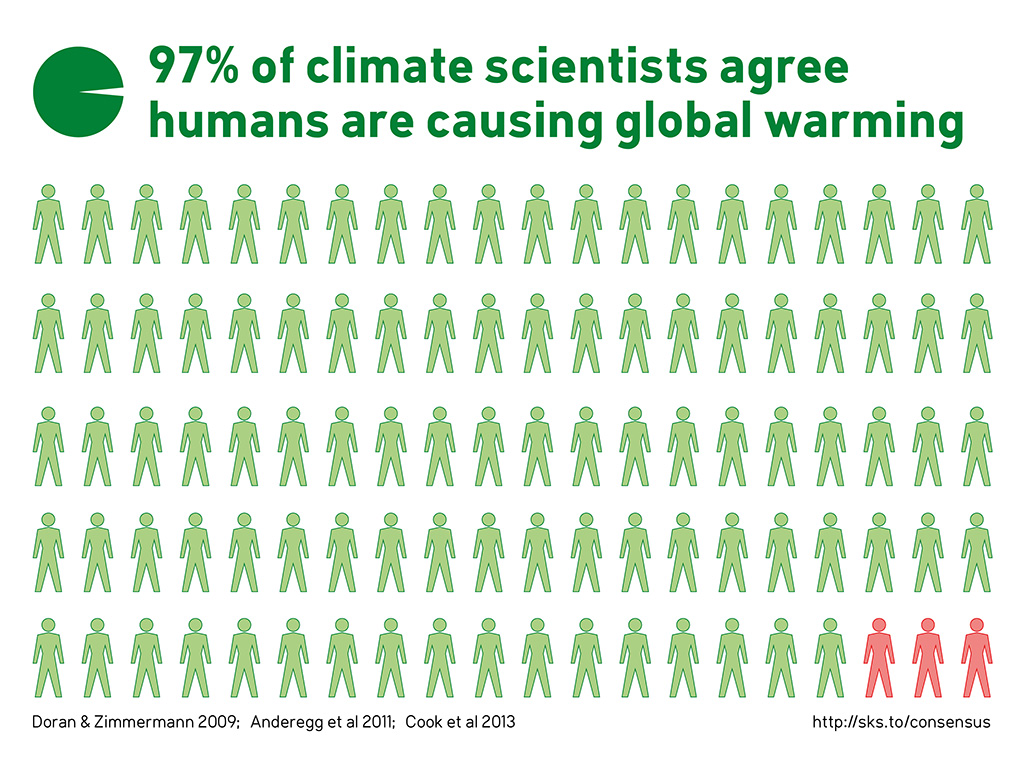
“97% of all climate scientists agree that human-made climate change is happening”— climate communication researchers regard this so-called consensus message as one of the most effective tools for reducing skepticism. How much does this number actually change in people’s minds? And what lies behind the oft-cited “Gateway Belief Model”?
This post was orginally published in German on klimafakten.de
Which questions do the studies address?
To better understand the impact of consensus messages, we look at two recent publications as well as two supplementary studies:
Jacob Rode et al. (2025) provide a large-scale meta-analysis. They summarize evidence from selected studies to clarify whether consensus messages increase the willingness to support climate change mitigation measures.
Jan-Pascal Göbel et al. (2026) investigate whether a consensus message can increase the effectiveness of subsequent information: Do people learn more from a video if they are presented with the scientific consensus shortly beforehand?
Additionally, we look at results from Nadia Said et al. (2022) and my own evaluations (Robin Tschötschel et al. 2021): We also specifically examined how the German audience reacts to this type of communication.
Which methodology was used, and why is it reliable?
Rode et al. (2025) use a meta-analysis in which datasets from nine selected studies with a total of 12,975 participants were combined and then evaluated. This form of analysis offers very high statistical reliability and is often used, especially in the medical field, to derive recommendations for action. However, the data mostly originate from the USA (seven out of nine studies), which means that caution is advised when generalizing to other countries.
The study by Göbel et al. (2026) is based on an experiment with 943 participants from Germany. “Pre-registration” guarantees that the research design is not changed ad hoc once the data is available. To achieve this, the research questions, hypotheses, and the methods to be used for data collection and analysis are published before the study is conducted. This significantly increases the credibility of the results, as it ensures that negative results are not suppressed, or methods changed to provide evidence for the researchers’ hypotheses.
The participants in the experiment by Göbel et al. (2025) were divided into three groups and were shown either a) the consensus message as described above, b) misinformation (“55% of scientists agree”), or c) no message at all. Afterwards, they watched an educational video and were then questioned to measure how well they could absorb the information from this video.
What are the key findings, and why are they relevant for climate communication?
The research by Rode et al. (2025) offers strong evidence for the logic of the so-called “Gateway Belief Model” (GBM). The idea behind it: The perception of scientific consensus acts as a gateway, with the following knock-on effects.
Those who learn that science is in agreement are more convinced that human-made climate change is happening. Furthermore, knowledge of a scientific consensus leads to greater concern regarding the issue and ultimately results in higher support for climate protection measures.
It is remarkable that the simple message “97% of all scientists agree” has such effects—and it provides communicators with a simple tool to bolster their messages. Even if the effect globally leads to only a slight increase in support for climate protection measures, the authors explain: “Even small effects can change societal discourse over time” (Rode et al., 2025, p. 4).
While various effects of such reinforcement of the scientific consensus are measured in the USA, these are almost negligible in Germany according to Tschötschel et al. (2021) and Said et al. (2022). This is mainly because the German audience is already comparatively well-informed and support for measures is generally very high. Dr. Mike Farjam (University of Hamburg) explains: “A so-called ‘ceiling effect’ could occur here, which means that the conviction that climate change is human-made can be influenced upwards only slightly.”
Nevertheless, Göbel et al. (2026) provide a particularly interesting result for educational practice, including in Germany: consensus messages lead to people actually learning more from subsequent informative videos. The message seems to increase receptivity—people possibly attach more importance to the following information or are more attentive when they know that the science behind it stands on a solid foundation. Prof. Dr. Michael Brüggemann (University of Hamburg) emphasizes: “It is plausible that this news leads to people becoming more open to absorbing new information.”
Göbel et al. (2026) also show that misinformation about a lack of agreement in science can briefly suppress the perceived consensus. However, if the correct information is presented shortly thereafter, the perception corrects itself upwards again.
What can be derived from the studies for practical application?
Consensus messages are not a “silver bullet” that solves all problems, but they can be a highly effective support tool. However, effects as strong as those in the USA are not to be expected with a German-speaking target group.
As Göbel et al. (2026) show, consensus information can be used as an entry point: before detailed facts or technical details are discussed, it makes sense to briefly explain the scientific consensus. This so-called priming increases the chance that viewers or readers “granted more credibility to the scientific sources [in the following video], which in turn could have led to a deeper engagement with the content” (Göbel et al., 2026, p. 6).
Since the consensus message itself can be minimal, a small graphic, such as a pie chart visualizing the 97% (or newer values of up to 99%), is often sufficient. In combination with a simple sentence, this information is quickly grasped.
As Professor Dr. Michael Brüggemann (University of Hamburg) emphasizes, “scientific consensus is very rarely explicitly mentioned in German news media.” Doing this more often can help reinforce the recognition of a scientific consensus, which would be a welcome side effect in view of rising skepticism towards science.
The principle can be applied to other areas where there is high agreement. For example, many economists agree that current CO2 prices are too low for a sufficient steering effect. And in other social sciences, too, there is a broad consensus that purely voluntary measures alone will not be enough to achieve climate goals. This agreement is not as well quantified numerically as it is among climate scientists.
This makes it somewhat more difficult to communicate with similar effectiveness. If necessary, it can be targeted to ask experts about their opinion on the degree of agreement in their field. Because those who emphasize the high level of agreement on various scientific topics provide the public with a compass to better categorize the relevance of political debates.
Further Reading
Jan Pascale Göbel, Buder, J., Ogiermann, M., Burkhardt, M., Forstner, A., Fischer, H., & Huff, M. (2026). Understanding the gateway: Unpacking the mechanisms, boundaries, and outcomes of climate consensus messaging. Journal of Environmental Psychology, 110, 102913. https://doi.org/10.1016/j.jenvp.2026.102913
Jacob B. Rode, Remshard, M., Groot, L. J., & van der Linden, S. (2025). A meta-analytic structural equation analysis of the Gateway Belief Model: Highlighting scientific consensus increases support for public action on climate change. Current Opinion in Behavioral Sciences, 63, 101521. https://doi.org/10.1016/j.cobeha.2025.101521
Nadia Said, Frauhammer, L. T., & Huff, M. (2022). Pre-registered replication of the gateway belief model – Results from a representative German sample. Journal of Environmental Psychology, 84, 101910. https://doi.org/10.1016/j.jenvp.2022.101910
Robin Tschötschel, Schuck, A., Schwinges, A., & Wonneberger, A. (2021). Climate change policy support, intended behaviour change, and their drivers largely unaffected by consensus messages in Germany. Journal of Environmental Psychology, 76, 101655. https://doi.org/10.1016/j.jenvp.2021.101655