
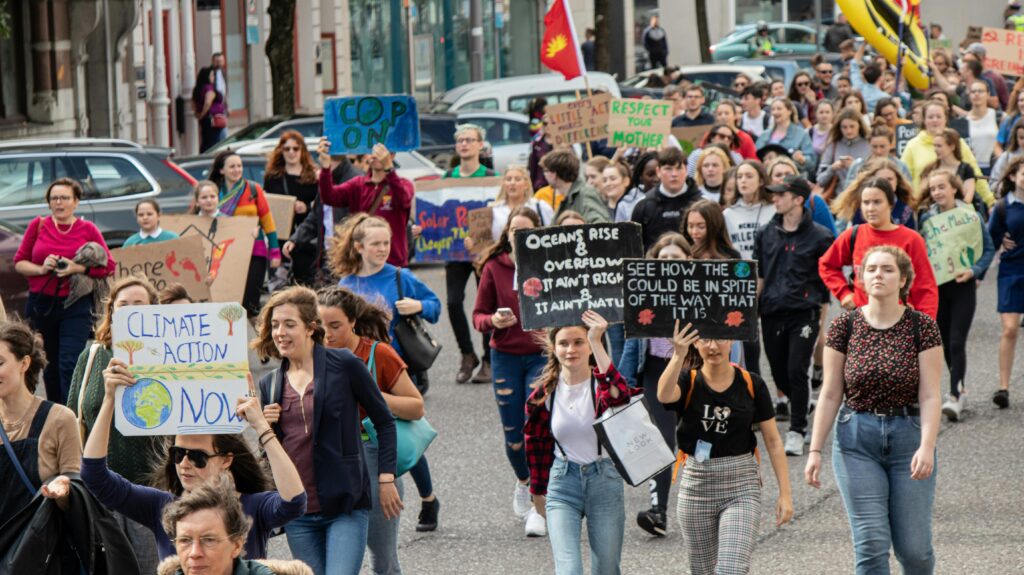
Young people will be most affected by the consequences of climate change, a problem which many of them are highly aware of. Yet in the increasingly entrenched and polarized climate debates, they are often more spectators than participants—partly because they have limited opportunities to play a role in political processes or influence decisions in business. How should climate communication address this discrepancy?
In this issue of “Study of the Month“, we discuss the publication “Climate Change Cognition, Affect, and Behavior in Youth: A Scoping Review” by Tapia-Echanove, et al. (2025). This post is also available in German on klimafakten.de: https://www.klimafakten.de/kommunikation/studie-des-monats-112025-so-erreicht-klimakommunikation-junge-menschen
What question does the study address?
This review study explores how young people (aged 15–24) engage with climate change. It focuses on the concepts of perception, cognition (the mental processes of understanding and meaning-making), affect (emotions and feelings), and behavior.
The aim of the study was to summarize existing research and determine what is already known about how young people deal with climate change, what evidence-based interventions can be derived from that knowledge, and where further research is still needed.
Which methodology was used, and why is it reliable?
The study applies the so-called scoping review method—a structured approach to reviewing scientific literature that promotes transparency and reproducibility, but produces a narrative summary of the literature. The process unfolded as follows:
First, the researchers defined clear research questions and established inclusion and exclusion criteria for selecting studies. They then identified relevant search terms and searched academic databases for suitable publications.
Next, the abstracts of all 610 identified studies were screened for relevance by multiple researchers. The remaining 355 studies were read in full, after which 301 were excluded, and six additional studies were identified through reference lists and added to the review.
The final set of 48 studies was then summarized and organized by theme within the article. While the scoping review method is highly reproducible, the way the included studies are interpreted still depends on the authors’ perspectives. Moreover, condensing a large number of studies into a few pages inevitably comes with a trade-off in terms of detail and precision.
What are the key findings, and why are they relevant for climate communication?
Many young people exhibit a high level of engagement and are well aware of their own ability to take action. They are generally well informed about climate change, although there are still some knowledge gaps—particularly when it comes to understanding different types of solutions. For example, the mistaken belief that nearly all environmentally friendly behaviors contribute equally to climate protection is widespread.
The study also highlights how important it is to pay attention to the emotions and feelings young people associate with the topic—and those that arise in response to messages about climate change and climate policy. It is essential to avoid giving the impression that the responsibility for climate protection is being shifted further onto young people.
Providing information about various solutions can indeed be encouraging for many. However, when individual responsibility is emphasized too strongly—especially in the face of limited societal and political action—this can lead to disillusionment, anxiety, and sometimes even anger toward the political system and wider society.
Hendrik Mayer, a PhD researcher in science and climate communication at the University of Hamburg, shares this perspective: “That young people sometimes feel powerless, and therefore demotivated, is actually a rational reaction to the political and economic situation.”
According to the article, one way to counter this is to emphasize collective—meaning community or society-wide—solutions. This could include presenting intergenerational initiatives and examples of collective action. Focusing on such shared solutions, the authors suggest, can help counter feelings of isolation and powerlessness that many young people experience.
While good communication can reach and engage many young people, if progress on climate protection at the political and societal levels remains limited, many will continue to experience negative emotions related to climate change.
Practical Implications of the Study
In general, communication with young people should start from the understanding that most in this demographic are well-informed and often actively engaged. Climate communication should ideally support existing engagement without creating additional pressure to “do more.”
Stay solution-focused
The study shows that most young people are well aware of human-caused climate change and understand that political and societal solutions are needed. However, many perceive a significant gap between their own willingness to act and the actions of political and economic actors.
This gap can lead to stress and excessive worry, sometimes causing disengagement, frustration, or anger—emotions that may, in turn, drive more radical forms of activism.
Effective climate communication should therefore also highlight which political and economic solutions are being discussed, which have already been implemented, and how young people’s engagement has contributed or could contribute to advancing these solutions.
Political actors, for example, can create more opportunities for young people to participate in decision-making and frame these as invitations rather than obligations. Media coverage can emphasize solutions that young people have helped shape or can influence—without shifting the responsibility for implementation onto them.
Emphasize collective responsibility and action
Although many young people are willing to act, they often face a “public goods dilemma”: seeing little action from others—particularly older generations with more resources—can make personal efforts feel futile.
To address this, climate communicators should emphasize the shared responsibility of all societal groups and sectors. This approach reassures young people that they are not alone in facing these challenges and motivates them to stay active in areas that might otherwise be seen as isolated or oppositional.
Focusing on collective action also helps reduce individual burden and strengthens belief in collective efficacy. Journalists, for example, can report on how activist groups successfully push solutions forward, while local authorities can show how their initiatives influence entire communities.
Finally, attention can be drawn to intergenerational initiatives or approaches that reduce the perceived distance between young people and the rest of society.
References
Tapia-Echanove, M., Bloch-Atefi, A., Hanson-Easey, S., Oswald, T. K., & Eliott, J. (2025). Climate Change Cognition, Affect, and Behavior in Youth: A Scoping Review. WIREs Climate Change, 16(1), e70000. https://doi.org/10.1002/wcc.70000