
In 2023, the long-term survey series “Down2Earth” detected a significant backlash on climate protection. Recently published data shows that this trend has progressed and intensified. The recent findings also suggest a rising skepticism regarding the existence of anthropogenic climate change. In 2025, the questionnaire additionally measured public support of discourses of climate delay (based on Lamb et al., 2020).
Since 2015, the research project “Down2Earth” has investigated public perceptions of climate change and climate politics as well as issue-specific media use, communication, and climate-friendly behaviour in Germany.
So far, the survey series includes six waves of data collection—always during the UN climate summits. In 2023, the survey data indicated a significant societal backlash on climate protection (see Reif et al., 2026; climate matters post).
With the data from the most recent survey wave (November 2025), the research team wanted to find out whether the backlash trend further continues. First results were recently published in an open-access research report (English) and a research paper in the German journal Media Perspektiven. In this article, we provide a short summary of the most important project results.
What are the key findings?
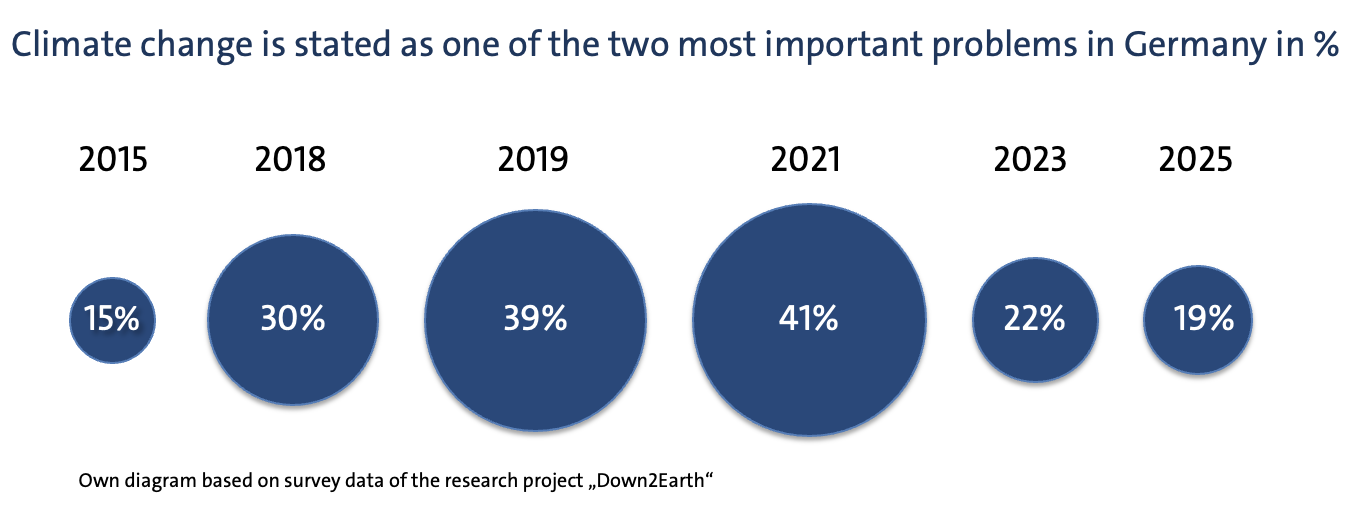
In 2023, the survey data indicated a backlash in climate change-related perceptions. This backlash has continued in 2025 and is consistent across different variables. For example, we observe significant decreases in the German population regarding problem prioritization, perceived personal relevance of climate issues, belief in climate change, efficacy beliefs, and support for climate policy.
Although only 19% of respondents rated climate change among the two most important problems for Germany, 50% considered climate change related issues to be rather or very important to them personally.
Declining information exposure
The number of respondents who receive information about climate change at least once a week further declined across all assessed (media) sources compared with 2023. Frequencies are largely back at the 2015 or 2018 level.
In 2025, the use of social media related to climate change and climate politics slightly declined for the first time in the time series.
Public broadcasting still remains the most frequently used source: 63% of respondents who receive information about climate change and climate politics at least once a week do so via public broadcasting (47% via private TV).
Conversations about climate change with other people have declined since the 2019 peak. Fewer participants reported discussing climate change/climate politics at least once a week with family and friends (34%) or colleagues (27%), a decline of -8% points compared with 2023.
Narrowing gap between skepticism and beliefs
Doubts about the existence of climate change continued to increase, reaching 26% of the population (+7–10%) after remaining stable from 2015 until 2021. 63% of respondents think climate change has serious consequences, while attributing current climate change mainly to human activities. After stability through 2021, this represents a decline of more than 10%.
Narratives of climate delay propagated by politicians also find strong resonance in public opinion, such as the (false) belief that we should focus on the development of new technologies to solve climate change (“technological optimism”) or that any action is futile as long as others do not act (“whataboutism.”) Nearly 60% of respondents agreed with these statements at least somewhat.
The silver lining: climate-friendly behaviour
Nevertheless, climate-friendly behaviour and behavioural intentions have remained comparatively stable over time. Almost half of respondents already limit or change their transportation (e.g., by reducing flights or car use) in favour of climate protection.
In sum, the results indicate a significant shift of public perceptions and highlight the importance of increased media attention (esp. on public TV) and continued conversations in individuals’ social environment. Even though climate-friendly behaviour remained stable, respondents think that their own behaviour as well as the behaviour of others would be less climate-friendly compared to previous years.
Further reading
Research report: Reif, A., Guenther, L., & Brüggemann, M. (2026). Down2Earth Report 2026: A long-term survey series on climate change perceptions, media use and behaviour in Germany. OSF Project DOI: 10.17605/OSF.IO/TXU5M. Link: https://osf.io/txu5m/files/z6hxu.
Research paper in Media Perspektiven: Reif, A., Brebeck, N., Guenther, L., & Brüggemann, M. (2026). Skepsis gegenüber Klimaschutz wächst: Langzeitstudie zu Einstellungen und Mediennutzung über den Klimawandel und die Klimapolitik in Deutschland. Media Perspektiven, 2026(16), 1-23. https://www.media-perspektiven.de/publikationsarchiv/2026/detailseite-2026/skepsis-gegenueber-klimaschutz-waechst
References
Lamb, W. F., Mattioli, G., Levi, S., Roberts, J. T., Capstick, S., Creutzig, F., Minx, J. C., Müller-Hansen, F., Culhane, T., & Steinberger, J. K. (2020). Discourses of climate delay. Global Sustainability. https://doi.org/10.1017/sus.2020.13
Reif, A., Guenther, L., & Brüggemann, M. (2026). Unveiling the Backlash in Public Opinion on Climate Change: A Longitudinal Study of Climate Change-Related Population Segments and Communicative Engagement in Germany. Environmental Communication, 20(2), 317–339 https://doi.org/10.1080/17524032.2025.2507006